In a lot of cities, somebody’s day starts before sunrise with a ring of keys and a route. The park restrooms. The pavilion storage room. The gate at the ballfield. The concession stand. Unlock, drive, unlock, drive. Then at dusk, the same route in reverse.
It isn’t anyone’s favorite part of the job, and it rarely shows up as its own line in the budget. But it happens every day, on weekends, on holidays, and in the rain. And it happens at exactly the buildings that have no one on site to notice when something goes wrong.
Most city buildings have staff inside during the day. Parks and public works buildings often don’t. That’s where the lock-and-unlock routine eats the most time, and where it fails most quietly. Here’s where the cost hides, and what changes when the doors keep their own hours.
Where the Route Costs You
Two trips a day, every day
Every unstaffed site on the route is two visits a day: one to open it and one to close it. That’s staff time, a vehicle, and fuel, multiplied by the number of sites, and it doesn’t stop on weekends. Someone has to cover it when the regular person is out sick or on vacation, too.
Seasonal hours that never quite match
A park that closes at dusk closes at a very different time in June than it does in December. In practice, the restrooms open and close whenever the route gets there. Posted hours and actual hours drift apart, and every schedule change means re-briefing whoever is driving the route.
The door that didn’t get locked
Miss one stop at the end of a long day and a restroom stays open all night. Nobody finds out until the next morning, usually because of what happened overnight. With no one on site, there’s nothing to catch the mistake in between.
Keys that walk away
Seasonal staff, contractors, recreation league coordinators, and volunteers all end up with keys at some point. Keys get copied, lent out, and not returned. Eventually the only fix is rekeying, and then the cycle starts again.
No record of who was there
When a city finds damage on a Monday, the first question is who was inside over the weekend. With metal keys, there’s no way to answer it.
What Changes When the Door Keeps Its Own Hours
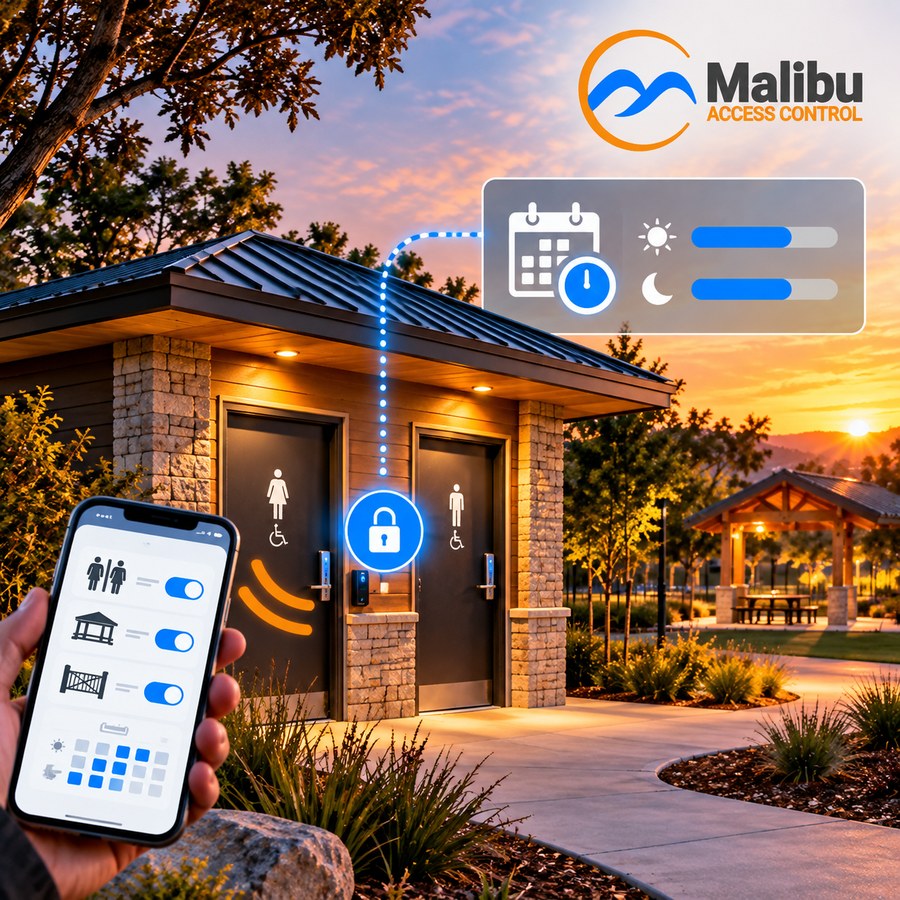
With a modern access control system, the door controller locks and unlocks on a schedule. The restrooms open in the morning and lock at closing time whether or not anyone drives by. When the season changes, the parks department changes the schedule once, in software, and every door on it follows along.
People who still need to get in outside those hours, like a maintenance crew, a contractor, or a league coordinator, get their own credential. It can be limited to the buildings and hours they actually need, and it’s turned off in software when the job or the season ends. There’s no key to collect.
Every entry is logged by credential and time. When there’s damage or a dispute, the city has a record to look at instead of a guess. And because no one has to drive the route, the people who used to do it get those hours back for the work that actually needs a person.
What if the park doesn’t have reliable internet?
Remote park buildings often sit at the end of a road with no reliable internet service, and that matters when you’re choosing a system. Access control generally comes in three forms: cloud-based, on-premise, or a hybrid of the two. Here’s what each one means for your buildings.
Malibu is a hybrid. The doors are run by equipment on-site, and the system connects back so the city can manage it remotely. Where a park doesn’t have reliable internet, a cellular modem is installed to provide that connection. That means a restroom at the far end of a park system can be managed just like a door at city hall.
How One City Runs Its Parks
One city parks department runs Malibu at 19 remote parks. Using Malibu’s remote connectivity, the city manages every one of those locations from one central place instead of sending someone out to each site.
From there, the city sets access levels for its employees, so each person can get into the buildings their job requires. It also sets the schedules for the restrooms and other amenities at every park. When hours change, the change is made centrally, and the parks follow it.
Buildings that already have an older system
Some city buildings already have an aging card or fob system. Replacing it is usually less disruptive than people expect. In most Malibu upgrades, the existing readers, locks, and wiring stay where they are, and the controller is the part that changes. Here’s how a typical upgrade works.
One System for Every Building a City Runs
Parks make the clearest case, but they’re rarely the only buildings a city is responsible for. The same system can run fire stations and apparatus bays, courthouses, public works yards, municipal offices, and park buildings, all from one console. Each department keeps the rules its buildings need, and the city doesn’t end up with a different system, a different vendor, and a different login for every one of them. See how cities use Malibu across every building type.
Questions Worth Asking Before You Choose a System
If unstaffed buildings are what’s driving your search, these are the questions that matter most:
- Can our own staff change door schedules when the season changes, or does it take a service call?
- If a remote site loses its internet connection, does the door still follow its schedule?
- Can we limit a contractor’s or volunteer’s access to specific buildings and hours?
- If we ever stop paying for a license, do the doors still work? (Here’s why that matters.)
- What will this cost over five years, not just on installation day? (Here’s how to compare.)
For a broader checklist, see 6 Questions to Ask an Access Control Dealer.
The Route Doesn’t Have to Be Anyone’s Job
Parks will keep opening in the morning and closing at night. What doesn’t have to keep happening is the drive, the forgotten stop, and the box of keys nobody can account for. When the door keeps its own hours, opening and closing time becomes something the system handles, not a route someone has to run.
See how Malibu works for municipal and government buildings. When you’re ready to talk about your sites, a certified Malibu Dealer can walk them with your parks or facilities team and scope which buildings are worth putting on a schedule. Find a Dealer near you.