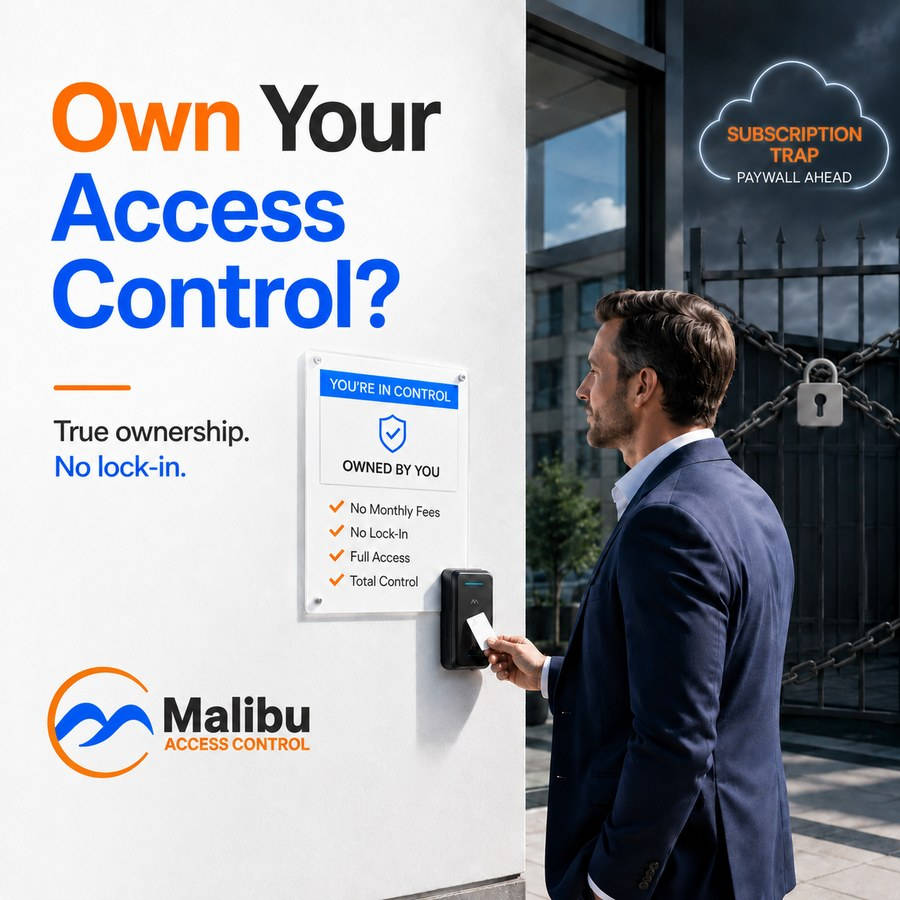
If you’ve ever looked into upgrading your building’s locks and keys to an electronic access control system, you’ve probably noticed something a little strange: most of these systems are sold like a security product, but billed like a streaming service.
Here’s a question worth asking before you sign anything: if you stopped paying tomorrow, would your doors still work?
For a lot of access control systems on the market today, the honest answer is no. And most business owners don’t find that out until years after installation — right when it’s the most expensive and disruptive time to discover it.
What “Ownership” Actually Means in Access Control
When you buy a car, you own the car. If you stop paying for satellite radio, the radio stops working — but the car still drives. That’s a reasonable tradeoff, because the core function of the product isn’t held hostage by the subscription.
Access control should work the same way. The hardware you install — the readers, controllers, and locks — is something you paid for outright. It should keep doing its core job (letting authorized people in and keeping everyone else out) whether or not you keep paying an ongoing fee.
The problem is, many access control systems are engineered so that even basic functionality — sometimes including mobile app credentials, remote management, or even day-to-day door access — depends on an active subscription. Stop paying, and you don’t lose a nice-to-have feature. You lose control of your building.
How the Subscription Trap Happens
It’s rarely intentional deception — it’s usually just how the business model is structured, and it’s easy to miss during the sales process:
- The system is quoted with an attractive upfront hardware cost.
- Licensing or “cloud” fees are described as optional or for “extra features.”
- A year or two in, it becomes clear that mobile credentials, software updates, or even login access to manage users requires that subscription to stay active.
- Switching providers means ripping out hardware and starting over, because the system was never designed to operate independently.
By the time this becomes obvious, you’re not just annoyed — you’re locked in. Replacing an access control system across an entire building is expensive and disruptive, so most owners just keep paying.
Questions to Ask Before You Buy
Before you sign a contract or approve a quote, ask your prospective Dealer these directly:
- What happens if I stop paying for the system? Get a specific answer, not “you probably won’t want to.”
- Do I actually own the hardware I’m purchasing, or am I licensing it?
- Does the system require internet connectivity to function, even for basic door access?
- What’s the real cost 3–5 years down the road — not just the installation quote?
- If I want to switch providers or Dealers later, can I? Or is the system proprietary to one vendor?
A Dealer who can answer these clearly and confidently — without hedging — is a good sign you’re dealing with a system built on transparency rather than lock-in.
The Malibu Approach
This is exactly the problem Malibu was built to solve. Our systems are designed so that the hardware you buy works — fully — whether or not you choose ongoing cloud licensing. Licensing adds real value (automatic nightly backups, pushed software updates, mobile credentials, and expert support), but the core function of your system — securing your doors — isn’t held hostage by it. Stop paying, and your building stays secure.
Next Step
If the answers you’re weighing are about a system you already own — and would rather leave — upgrading from an old key fob system covers what a switch actually involves. In most retrofits the readers, locks, and wiring stay put and only the controller changes.
If you’re evaluating access control for your business — whether it’s a single office or a portfolio of properties — it’s worth asking these ownership questions of any Dealer before you commit. If you’d like to talk through your specific building’s needs, connect with a Malibu Dealer near you and get straight answers.