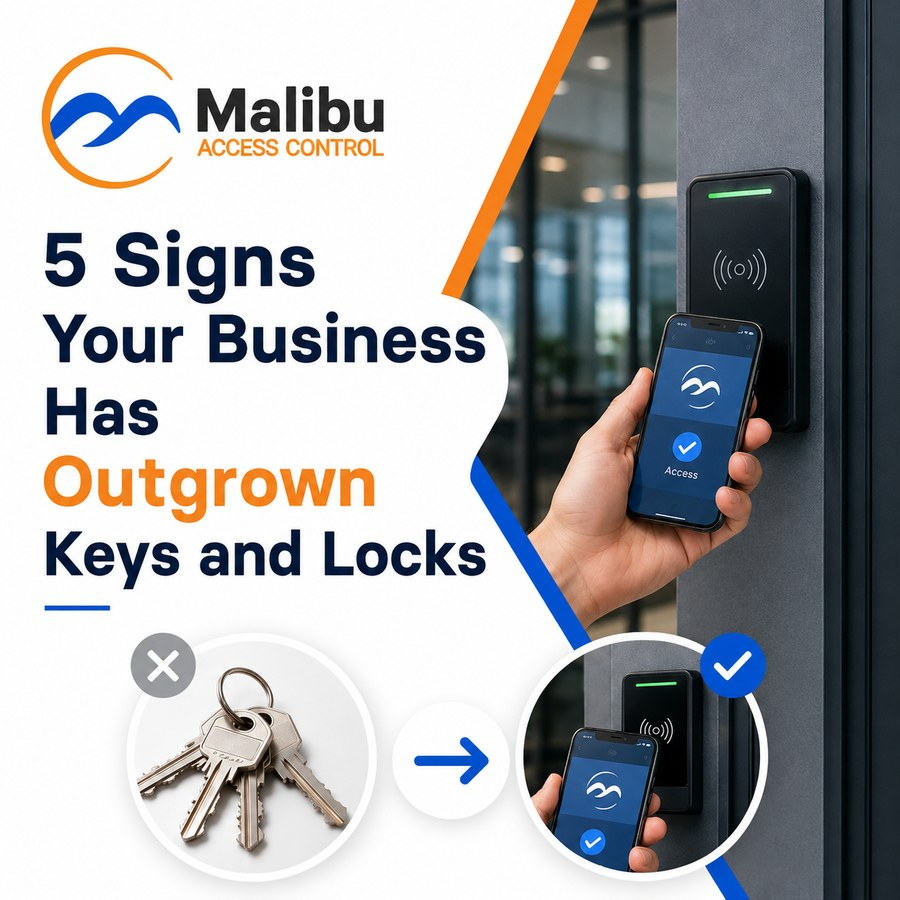
You hand a new hire a key on their first day. Six months later they leave, and you’re left wondering: did they ever make a copy? Did the last three people who left?
For a lot of business owners, that question never gets an answer — because there isn’t a good way to get one with a traditional lock. Keys don’t tell you who used them, when, or where. That’s fine when you’re a two-person shop with one door. It stops being fine as the business grows.
Here are five signs it’s time to think about something better.
1. You’ve Lost Count of Who Has a Key
Every business starts out able to name exactly who’s holding a key. Then someone gets promoted, a contractor needs after-hours access for a project, a former employee “forgets” to return theirs — and a year later, nobody’s entirely sure how many keys are actually out there, or who has one.
The only real fix with a traditional lock is rekeying: paying a locksmith to swap the cylinders and cut a new batch of keys, every time you want a clean slate. Most businesses stop doing this regularly simply because it’s a hassle, which means the gap between “who should have access” and “who could have access” just keeps widening.
2. Turnover Means Constant Rekeying
If your team changes often — retail, hospitality, and food service tend to see this the most — rekeying isn’t a once-a-year event, it’s a recurring line item. Every departure is a small fire drill: schedule the locksmith, cut new keys, redistribute them to everyone who’s still there.
With electronic access, removing someone’s access is a two-minute task, not a service call. You deactivate their credential and the door instantly stops recognizing it — no locksmith, no rekeying, no waiting. Apartment and condo communities face the same problem with residents instead of staff — see how resident turnover quietly costs money.
3. You Have No Idea Who Came and Went, or When
If something goes missing, or a door is found unlocked that shouldn’t be, a key gives you nothing to go on. Anyone who’s ever had one theoretically could have opened that door, and you have no way to narrow it down.
Electronic access control keeps a simple log: who badged in, at which door, and at what time. You may never need to look at it — but the day you do, it’s the difference between having an answer and just having a guess.
4. You’re Managing Access for More Than Just Employees
Cleaning crews, contractors, delivery drivers, part-time staff — the more categories of people who need to get in, the harder keys are to manage well. Do you give a cleaning crew a key that also opens your server room? Do you trust that a contractor’s key gets returned when the job wraps up?
Electronic credentials can be scoped narrowly — a specific door, a specific time window — and set to expire automatically. A contractor’s access can end the day the job does, without anyone needing to remember to collect anything.
5. You’re Opening a Second Location, or Adding After-Hours Access
One door, one lock, one set of keys is simple. Two locations — or one location where different people need in at different hours — is where keys start to break down. You either issue a full set of keys to everyone regardless of which building or shift they’re actually working, or you deal with the logistics of matching the right keys to the right people at the right sites.
Modern access control systems are built to handle exactly this. You can set different access schedules and permissions per person, per door, across as many locations as you have — managed from one place instead of a growing pile of physical keys. This is one of the most common reasons growing businesses make the switch — see how it plays out for single-door storefronts and multi-site operations.
What This Doesn’t Mean
None of this means you need to rip out every lock in the building tomorrow. Most businesses that switch don’t convert every door — they start with the ones that matter most (a main entrance, a server room, a stockroom) and expand from there as it makes sense. Access control isn’t a huge leap technically — it’s really the same idea as a lock and key, with software making the “who has access” question easy to answer instead of impossible.
If you’re weighing the switch, it’s worth understanding the real cost over time, not just the installation quote, and knowing the right questions to ask before you pick a Dealer to work with.
Next Step
The fastest way to find out where you stand is to have someone look at the doors. A certified Malibu Dealer can walk your space and tell you exactly which doors are worth switching first — find a Dealer near you.